By Propzine – Bengaluru’s Trusted PropTech Platform
Understanding the capitalization rate, or cap rate, is one of the most important skills for anyone evaluating real estate investments. Whether you’re a first-time investor, an institutional buyer, or an NRI comparing Indian cities for yield, knowing how cap rates work can help you make clearer, data-driven decisions. In a market like Bengaluru—India’s fast-growing proptech and real estate hub cap rate analysis has become a standard metric to evaluate both residential and commercial assets.
This guide breaks down the cap rate formula in real estate, explains how to calculate cap rate, and discusses how investors use it alongside other real estate ROI metrics to screen deals. You’ll also learn how low versus high cap rates impact property valuation, when cap rates should not be used, and how Propzine’s proptech tools help automate comparisons across Bengaluru’s micro-markets.
What Is Cap Rate? A Simple Definition
A capitalization rate represents the expected annual return from an income-generating property, expressed as a percentage. It tells an investor how much yield a property can deliver purely from operations excluding loan payments, taxes, and appreciation.
The core idea is straightforward:
Cap Rate = Net Operating Income (NOI) ÷ Current Property Value
This ratio is widely used by investors, developers, REITs, and analysts because it offers a quick snapshot of property performance. In a high-demand market like Bengaluru, where rental yields are comparatively lower than Tier-II cities, knowing the cap rate helps investors evaluate whether the pricing truly justifies the expected income.
How to Calculate Cap Rate: Step-by-Step Breakdown
To understand how cap rates work in real-world scenarios, follow this three-step calculation:
1. Determine Net Operating Income (NOI)
NOI = Gross Annual Rent – Operating Expenses
Operating expenses generally include maintenance, property management, utilities (if paid by owner),
vacancy loss, insurance, and repairs.
2. Identify the Market Value of the Property
This can be either:
• The purchase price, or
• The current market valuation
3. Apply the Cap Rate Formula
Cap Rate = NOI ÷ Property Value
What Cap Rate Tells You And Why It Matters
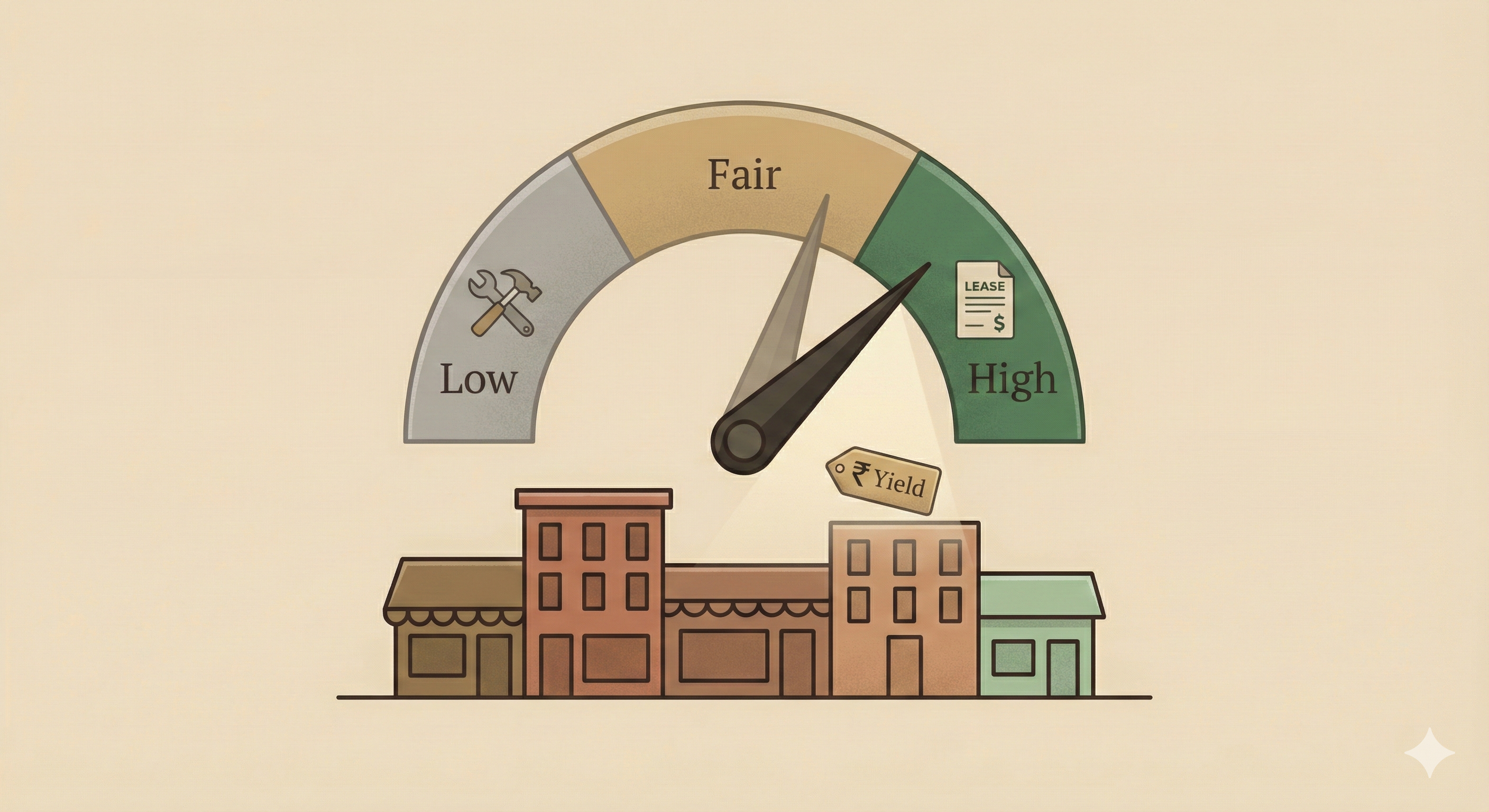
Cap rate is a reflection of risk, return, market demand, and asset efficiency. A higher cap rate usually indicates higher risk but greater potential return, while a lower cap rate suggests stronger demand and higher property values, but lower annual yield.
In Bengaluru’s context:
• Grade-A offices in Whitefield or Outer Ring Road tend to have lower cap rates due to stronger
corporate demand.
• Standalone commercial assets or older buildings may offer higher cap rates but come with higher
risk and vacancy concerns.
Investors often use cap rates as a quick screening tool. A common benchmark is the 6–8% minimum threshold for commercial assets. Anything below this range requires strong evidence of appreciation potential or location advantage.
Cap Rate vs ROI: When to Use Each Metric
While cap rate focuses solely on the property’s operating performance, ROI considers the investor’s entire cost structure—including down payment, loan interest, and taxes.
Use Cap Rate When You Want To:
• Compare multiple properties quickly
• Assess pure rental performance
• Evaluate market-level demand and pricing
• Screen commercial assets or REITs
Use ROI When You Want To:
• Understand returns after financing
• Evaluate long-term wealth creation
• Include appreciation and tax benefits
• Analyze personal cashflow and leverage
Cap rate is a property metric. ROI is an investor metric. Smart decision-making requires looking at both.
Cap Rates and Property Valuation: The Inverse Relationship
One of the most powerful insights for investors is understanding how cap rates control property value.
Because the formula divides NOI by cap rate, even a small shift can dramatically change valuation. For example:
• A property with ₹10 lakh NOI at a 5% cap rate is valued at ₹2 crore
• At a 6% cap rate, its valuation drops to ₹1.66 crore
This inverse relationship is why markets like Bengaluru where demand is strong and rental supply is limited naturally have lower cap rates. Investors accept lower yields because long-term appreciation compensates for reduced annual income.
How Investors Use Cap Rate Thresholds to Screen Deals
Most seasoned investors apply cap rate filters early in deal screening. Some common thresholds include:
• Below 5%: Only acceptable for luxury, prime micro-markets, or high-appreciation zones
• 6–8%: Ideal range for commercial investments
• Above 9%: Potentially high return but may involve leakage, risk, or outdated assets
This filtering process helps narrow down properties based on income potential before diving deeper into leasing history, tenant quality, or market trends.
How Proptech Tools Are Transforming Cap Rate Analysis
At Propzine, Bengaluru’s home-grown proptech platform, automated cap rate analytics allow investors to compare dozens of properties within seconds. Our digital valuation tools help track:
• Micro-market rental benchmarks
• Comparable property values
• True NOI after factoring maintenance and vacancy
• Dynamic cap rate heatmaps
• Investment-grade insights for commercial and residential users
This technology ensures that buyers, NRIs, and institutional investors don’t rely on outdated or fragmented data. Instead, they receive real-time, accurate valuations tailored to Bengaluru’s fast-evolving real estate landscape.
Final Thoughts: Cap Rate Analysis Is the Foundation of Smart Investing
Whether you’re exploring commercial spaces in HSR Layout, retail units in Koramangala, or offices along Outer Ring Road, understanding cap rates gives you a clear starting point for evaluating any deal. It helps cut through market noise and brings the focus back to fundamentals income, value, and risk.
As India’s real estate ecosystem becomes more data-driven, cap rate analysis will play an increasingly critical role in investment decisions. And with proptech platforms like Propzine leading the shift toward automated valuation tools, investors now have access to the insights they need to make confident, profitable choices.